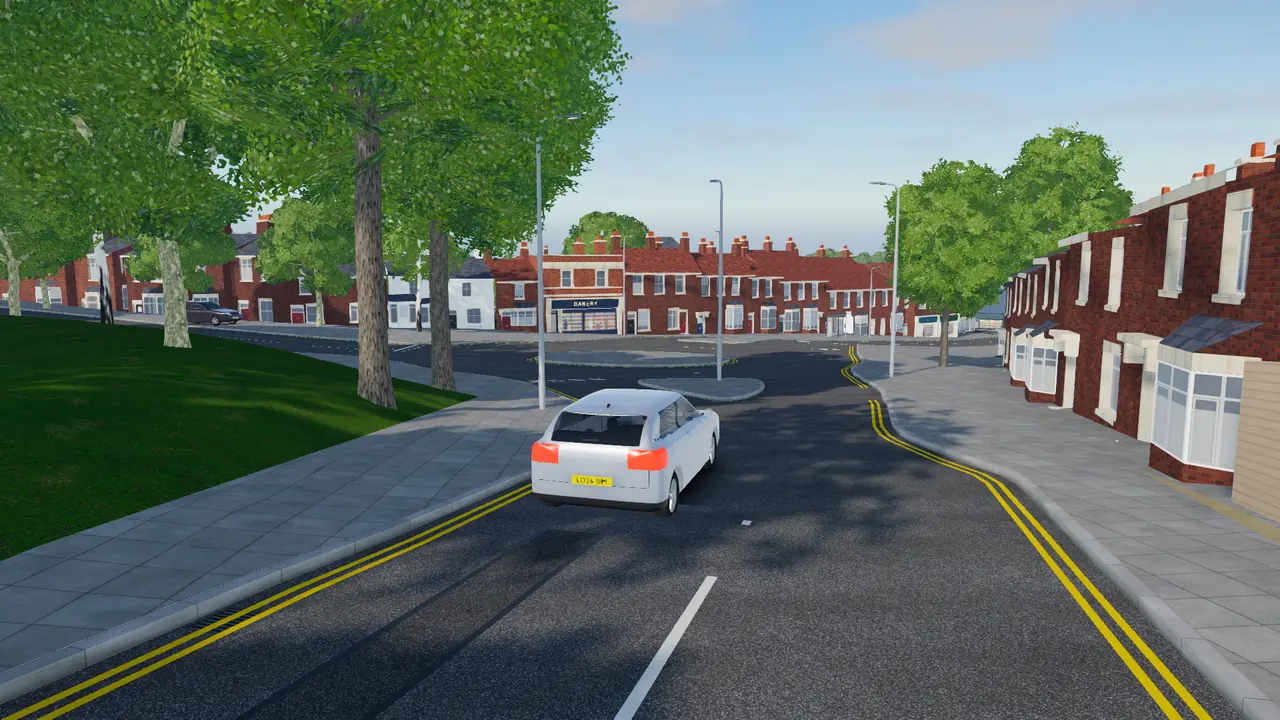
The 10-metre rule
Rule 243 of The Highway Code lists places where you should not stop or park. One is "opposite or within 10 metres (32 feet) of a junction, except in an authorised parking space". The rule applies except when you are forced to stop by stationary traffic.
Other places not to stop or park
Rule 243 also says do not stop or park:
- near a school entrance
- anywhere you would prevent access for Emergency Services
- at or near a bus or tram stop or taxi rank
- on the approach to a level crossing or tramway crossing
- near the brow of a hill or hump bridge
- opposite a traffic island or (if this would cause an obstruction) another parked vehicle
- where the kerb has been lowered to help wheelchair users and powered mobility vehicles
- in front of an entrance to a property
- on a bend
- where you would obstruct cyclists’ use of cycle facilities.
Advice and the law
Rule 243 is written as advice ("DO NOT"), not as a legal requirement ("MUST NOT"). But rule 242 is the law: you MUST NOT leave your vehicle or trailer in a dangerous position or where it causes any unnecessary obstruction of the road. And The Highway Code says that although breaking its advisory rules will not, in itself, get you prosecuted, it may be used in evidence in court.
Where parking is against the law
These rules say MUST NOT, which in The Highway Code marks a legal requirement:
| Place | The Highway Code says | Rule |
|---|---|---|
| Yellow lines, during the times shown on nearby time plates | You MUST NOT wait or park (double yellow lines: at any time) | 238 |
| A pedestrian crossing, including the area marked by the zig-zag lines | You MUST NOT stop or park | 240 |
| A road marked with double white lines, even when a broken white line is on your side | You MUST NOT stop or park, except to pick up or set down passengers, or to load or unload goods | 240 |
| The carriageway or hard shoulder of a motorway | You MUST NOT stop or park, except in an emergency | 240 |
| A dangerous position, or where it causes any unnecessary obstruction | You MUST NOT leave your vehicle there | 242 |
| The pavement in London or Scotland | You MUST NOT park partially or wholly on it | 244 |
On the crossing rule, see can you park on the zig-zag lines of a zebra crossing?. And for getting past cars parked near a junction, passing parked cars: when to move out.
In Scotland
In Scotland you MUST NOT double park or park anywhere the kerb has been lowered to help pedestrians or cyclists (rule 243, under the Transport (Scotland) Act 2019). Exceptions are allowed in limited circumstances.
The junction in the video
The video was filmed where Don Street meets St Machar Drive (B991) in Old Aberdeen, near the University of Aberdeen's King's Museum.
Practise it in Old Aberdeen
The video was filmed in DriveSim's 3D rebuild of Old Aberdeen, built from open map data: the real lanes, road markings and buildings. Drive the same streets free and try it for yourself.