National speed limits by vehicle (Highway Code rule 124)
The national speed limit is not one number. It depends on the road and on what you are driving. These are the limits in The Highway Code's table, in mph:
| Vehicle | Built-up areas | Single carriageway | Dual carriageway | Motorway |
|---|---|---|---|---|
| Cars and motorcycles | 30* | 60 | 70 | 70 |
| Cars towing a caravan or trailer | 30* | 50 | 60 | 60 |
| Motorhomes up to 3.05 tonnes | 30* | 60 | 70 | 70 |
| Motorhomes over 3.05 tonnes | 30* | 50 | 60 | 70 |
| Buses, coaches and minibuses up to 12 metres long | 30* | 50 | 60 | 70 |
| Goods vehicles up to 7.5 tonnes | 30* | 50 | 60 | 70 (60 if articulated or towing a trailer) |
| Goods vehicles over 7.5 tonnes, England and Wales | 30* | 50 | 60 | 60 |
| Goods vehicles over 7.5 tonnes, Scotland | 30 | 40 | 50 | 60 |
* 20 mph in built-up areas in Wales. The car limits also cover car-derived vans up to 2 tonnes maximum laden weight. Motorhome weights are maximum unladen weight; goods vehicle weights are maximum laden weight. Buses, coaches and minibuses over 12 metres long are limited to 60 mph on motorways.
You MUST NOT exceed the maximum speed limits for the road and for your vehicle (rule 124).
The limits for cars
The Highway Code's speed limit table (rule 124) gives these limits for cars and motorcycles, including car-derived vans up to 2 tonnes maximum laden weight:
- built-up areas: 30 mph in England and Scotland, 20 mph in Wales
- single carriageways: 60 mph
- dual carriageways: 70 mph
- motorways: 70 mph.
You must not exceed the maximum speed limits for the road and for your vehicle.
What the national speed limit sign means
The sign is a white circle with a black diagonal stripe, and The Highway Code's caption for it is "National speed limit applies". It shows no number, so you work the limit out from the road you are on and the vehicle you are driving: in a car, 60 mph on a single carriageway and 70 mph on a dual carriageway.
Single or dual carriageway?
The Highway Code's definition: "A dual carriageway is a road which has a central reservation to separate the carriageways." It is the central reservation that makes the difference, not the number of lanes. A road with two lanes each way and only paint between the directions is still a single carriageway, so the car limit there is 60 mph.
Street lights and no signs
A speed limit of 30 mph, or 20 mph in Wales, generally applies to all roads with street lights (excluding motorways) unless signs show otherwise (rule 124). So no speed sign on a lit street does not mean the national limit.
Rule 124 also says that locally set limits may apply, and gives these examples: 20 mph (rather than 30 mph) in some built-up areas in England and Scotland, 30 mph (rather than 20 mph) in some built-up areas in Wales, 50 mph (rather than 60 mph) on single carriageways with known hazards, and variable speed limit signs on some motorways and dual carriageways.
Towing is slower
Cars towing caravans or trailers have lower limits: 50 mph on single carriageways and 60 mph on dual carriageways and motorways (rule 124).
A limit, not a target
The speed limit is the absolute maximum and does not mean it is safe to drive at that speed irrespective of conditions (rule 125). Not driving at a safe and reasonable speed is the No. 10 reason learners fail the car test (DVSA, April 2024 to March 2025).
More on that in is the speed limit a target?, and on the gap to leave at speed in the two-second rule in rain and ice. Our stopping distances calculator shows The Highway Code's figures for each speed.
The street in the video
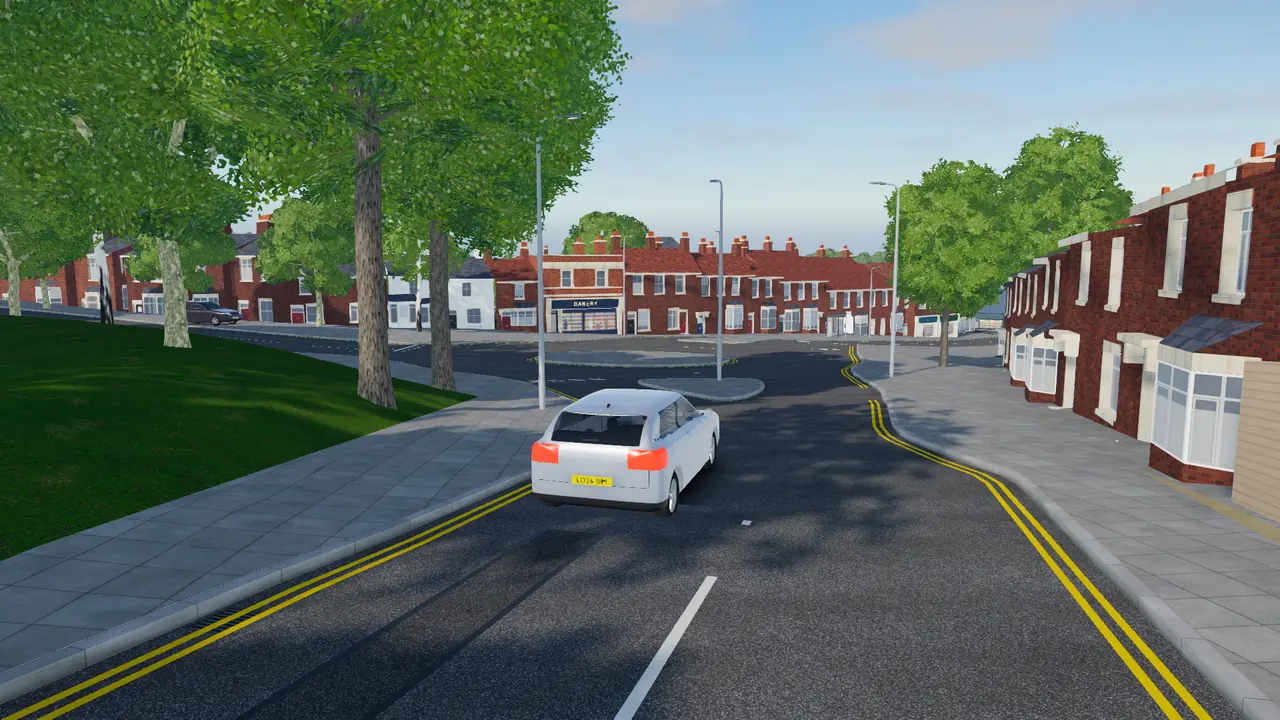
The quiz in the video was filmed on Wanstead High Street in east London, near Christ Church. It shows the rule for lit roads, not this street's own limit: always follow the signs.
Practise it in Wanstead, London
The video was filmed in DriveSim's 3D rebuild of Wanstead, London, built from open map data: the real lanes, road markings and buildings. Drive the same streets free and try it for yourself.