What rule H1 says
Those in charge of vehicles that can cause the greatest harm in the event of a collision bear the greatest responsibility to take care and reduce the danger they pose to others. The principle applies most strongly to drivers of large goods and passenger vehicles, vans and minibuses, cars and taxis, and motorcycles.
Everyone has a part
Cyclists, horse riders and drivers of horse drawn vehicles likewise have a responsibility to reduce danger to pedestrians. None of this detracts from the responsibility of all road users to have regard for their own and other road users' safety.
Turning across a cyclist
Rule H3 says you should not cut across cyclists going ahead when you turn into or out of a junction. Give way to them, and don't turn if it would make them stop or swerve.
The junction in the video
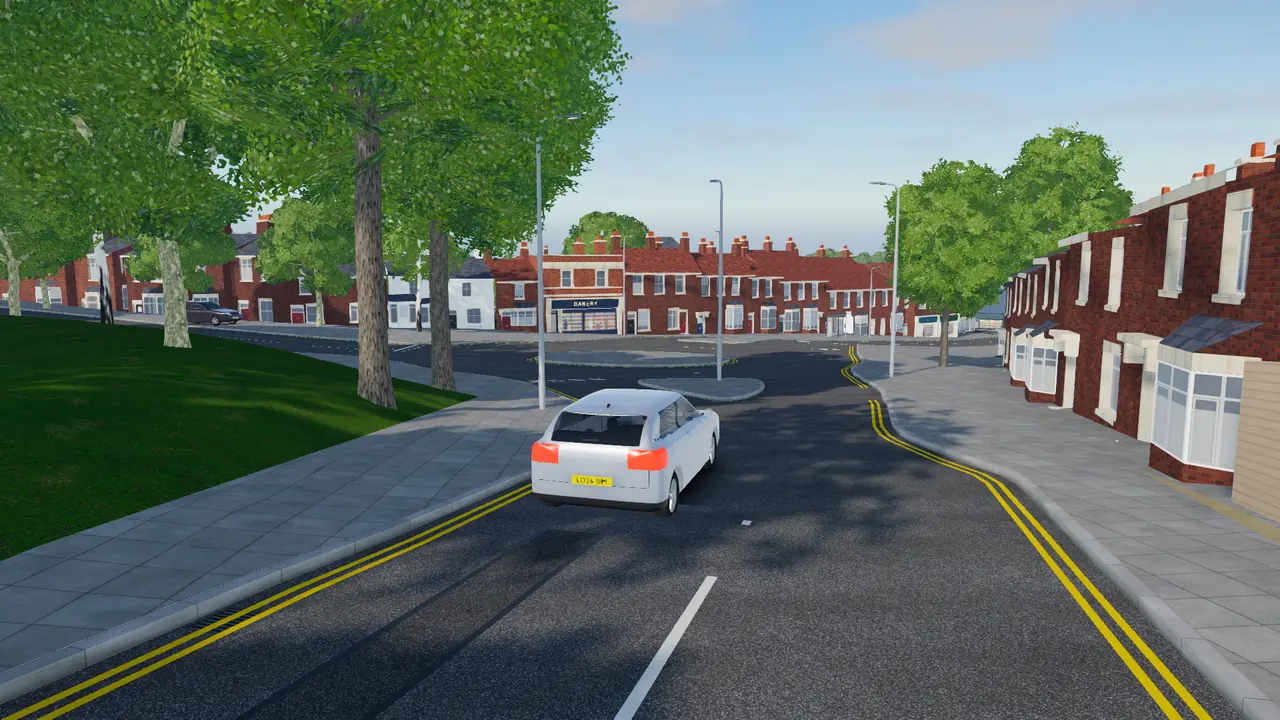
The video was filmed at a T-junction in Hendon, London. The game doesn't draw cyclists, so the quiz is shown on a frozen frame.
Practise it in Hendon, Beaufort Park, London
The video was filmed in DriveSim's 3D rebuild of Hendon, Beaufort Park, London, built from open map data: the real lanes, road markings and buildings. Drive the same streets free and try it for yourself.