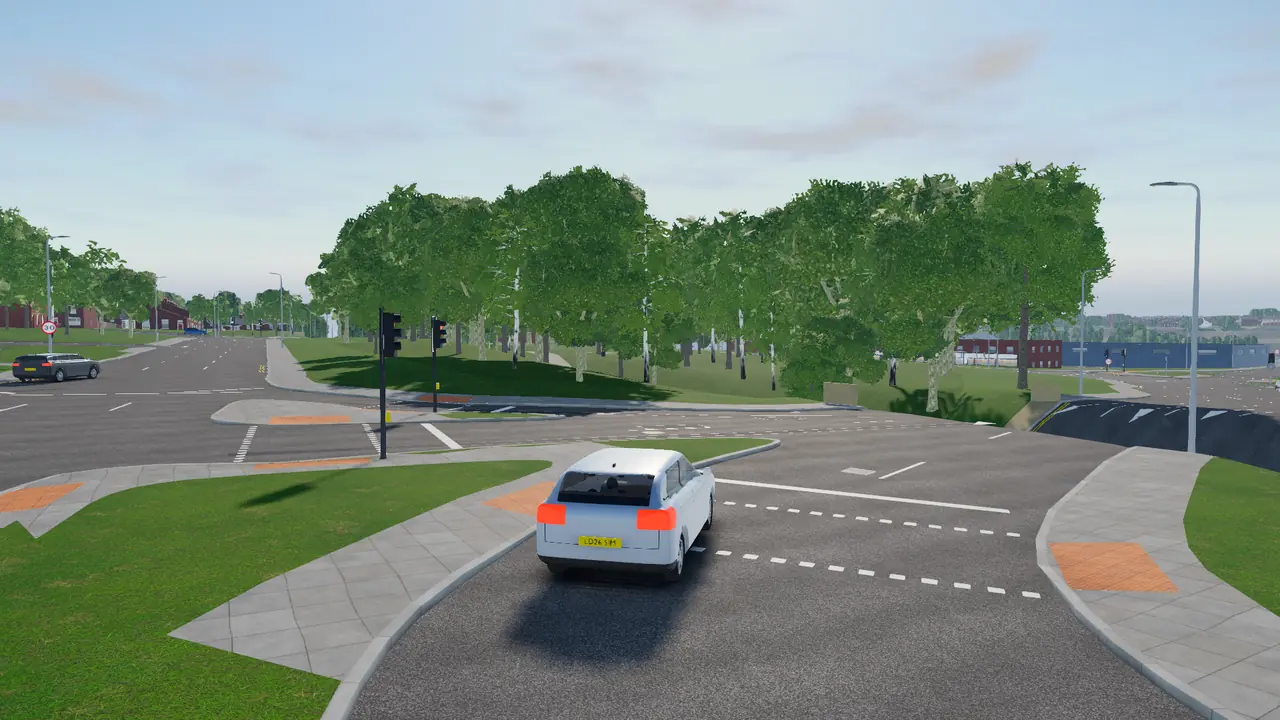
What each traffic light means
| Light | What The Highway Code says it means |
|---|---|
| Red | 'Stop'. Wait behind the stop line on the carriageway |
| Red and amber | Also means 'Stop'. Do not pass through or start until green shows |
| Green | You may go on if the way is clear. Take special care if you intend to turn left or right, and give way to pedestrians who are crossing |
| Amber | 'Stop' at the stop line. You may go on only if the amber appears after you have crossed the stop line, or you are so close to it that to pull up might cause an accident |
So amber is a stop signal with one narrow exception, not a warning to hurry.
What amber means
Rule 175 of The Highway Code: you MUST stop behind the white 'Stop' line across your side of the road unless the light is green. If the amber light appears you may go on only if you have already crossed the stop line or are so close to it that to stop might cause a collision.
Is it illegal to go through an amber light?
Rule 175 says you MUST stop behind the white 'Stop' line unless the light is green, and The Highway Code's MUST rules are legal requirements. The rule itself carries the exception: you may go on if you have already crossed the stop line when the amber appears, or are so close to it that to stop might cause a collision. Outside that exception, driving on through amber breaks the rule.
The practical answer is in the approach: come up to green lights at a speed you could stop from, check your mirrors early, and decide before the line, not on it.
Green isn't always go
Only go forward when the lights are green if there is room for you to clear the junction safely or you are taking up a position to turn right (rule 176). You MUST NOT move forward over the white line when the red light is showing.
See can you always go on a green light? and what a green filter arrow means.
The UK sequence
UK traffic lights run red, red and amber, green, amber, then red again. Red and amber together still mean stop: you must not go until green shows.
More on that moment in red and amber together: can you go?
What examiners mark
Not responding appropriately to traffic lights is the No. 5 reason learners fail the car test (DVSA, April 2024 to March 2025). DVSA's examples include trying to go through on a clear red, stopping beyond the first white line at an advanced stop line for cyclists, and waiting at a clear junction on green, or going ahead on green when the junction isn't clear.
Other things that happen at the lights
The lights in the video
The video was filmed at the traffic lights on The Broadway (A219) in Wimbledon, at Montague Road and Trinity Road, near Holy Trinity church.
Practise it in Wimbledon, London
The video was filmed in DriveSim's 3D rebuild of Wimbledon, London, built from open map data: the real lanes, road markings and buildings. Drive the same streets free and try it for yourself.